
What is Roll Back Memory?
To better understand the difficulties that people with dementia experience in relation to their understanding of memory and who they are, what they are doing and how they see others, it is important to understand the ways in which memories are stored and subsequently damaged by dementia.
Diana Kerr states “we have two kinds of memory, short-term and long-term memory. New information is stored in our short-term memory for about 20-30 seconds before being transported into our long-term memory.” (Kerr, 2007)
When someone develops dementia, however, the ability to retain memories by moving them back into the long-term memory breaks down and eventually memories are unable to be moved into the long-term memory at all.
This means from the moment dementia onsets, the amount of information able to be stored reduces.
3 keys of learning will be explored in this blog:
- Shelf of yearly Diaries and Roll Back Memory
2. Proactive attention to every day details e.g. like hand dryer
3. Mirrors – be aware the person may not recognise themselves
- Shelf of Diaries
Hubb Buijssens The Simplicity of Dementia (2005)
A great way to better understand the way memory works is to look closely at Buijssens “Shelf of Diaries” illustration.
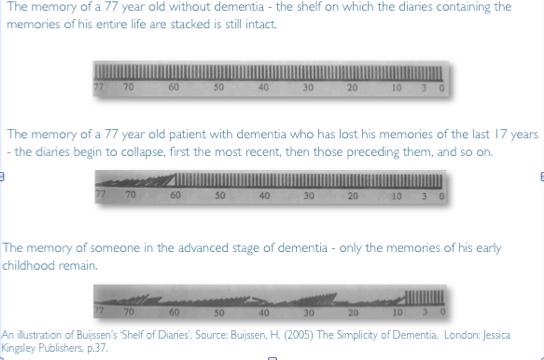
It should be noted that not all diaries roll back. Memories which are revisited time and time again are reinforced and may remain.
2. Proactive attention to every day details e.g. a hand dryer
Imagine a time before the electric hand dryer. If you woke up one day and had only used a towel to dry your hands, you would be very confused by the many different forms which hand dryers come in today.
For those with dementia, this is a common problem. Without access to the last 20 years of memories, they know only a world pre-hand dryer.
This means when faced with an object that they do not recognise they will likely feel anxious and stressed. It is important to try to avoid stress for people with dementia.
3. Mirrors – be aware the person may not recognise themselves
Mirrors can also pose a problem for people with dementia. They can lead to people with dementia feeling frightened or confused. “Because of the loss of recent memory, the person no longer sees themselves as the age they are. If they look into a mirror the person they see will not tally with their own self-image, which is of a younger person” (Kerr, 2007)
For this reason, people with dementia may wave at a mirror or their own reflection, as they do not recognise it to be themselves.
So we begin to understand the hurdles that people with dementia face and how we as their support can help them navigate this world which is partly in the present and partly of memories. When we understand their frame of reference so we are able to assist them live their lives to the full.
References:
Diana Kerr (2007) Understanding Learning Disability and Dementia: Developing Effective
Buijssen, H. (2005) The Simplicity of Dementia. London: Jessica Kingsley Publishers, p.37.
Contact Us
We hope you have found the information on this website helpful. Drop us an email if you have any questions or suggestions on how we can help you further.

Anna White
Learning Disabilities and Dementia Care Trainer
Keynote Conference Presenter
Email: LDCareTraining@gmail.com

Dr Karen Dodd
Consultant Clinical Psychologist
Keynote Conference Presenter
Author
Email: LDCareTraining@gmail.com

Diana Kerr
Dementia Consultant
Associate Consultant to HammondCare
Keynote Conference Presenter
Researcher Learning Disability and Dementia
Author
Email: LDCareTraining@gmail.com
Fill out the form below to make an enquiry, as well as receiving your free report on the 5 Tips to helping someone who has Learning Disabilities and may have Dementia.